


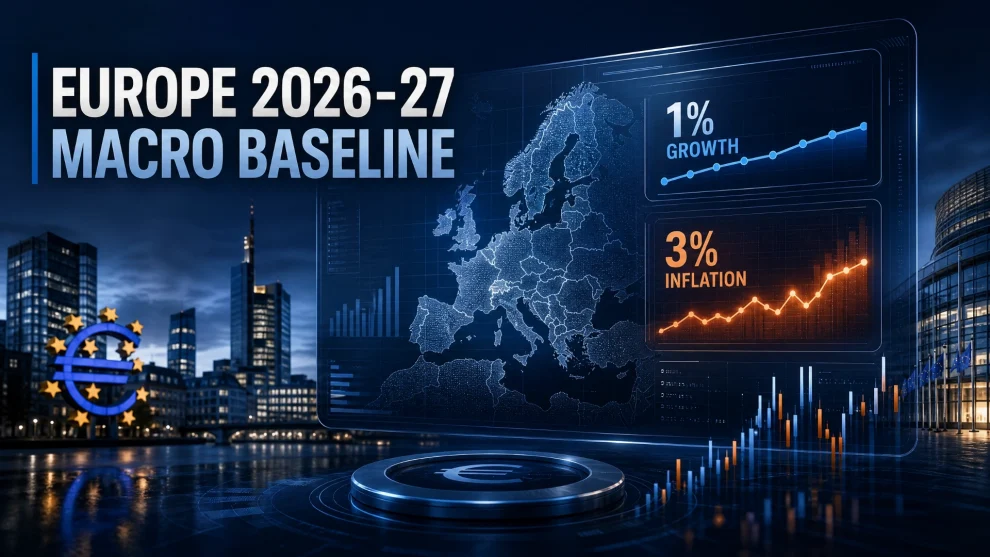
The euro area is stuck near 1% growth while headline inflation hovers around 3%. That’s not a crisis – but it isn’t the old low‑inflation world either.
In Short – Key Takeaways
- The Conference Board now expects euro‑area growth of about 1.0% in 2026 and 1.1% in 2027 – essentially a “slow lane” baseline.
- Headline inflation is projected to reach around 3.0% in 2026 before easing to roughly 2.5% in 2027 as energy pressures fade but do not fully reverse.
- Core inflation is seen staying much closer to the ECB’s 2% target, gradually decelerating from 2.4% in 2025 to 2.3% in 2026 and 2.2% in 2027.
- A three‑lens framework – level, composition, reaction‑function – helps make sense of this “slow but hotter” regime.
- For investors and banks, the key is how 1% growth and 3% inflation reprice rates, credit risk and the euro, rather than any single data print.
The Baseline: Not Stagnation, Not Boom
Europe’s latest forecasts sit in an awkward middle ground. On the growth side, GDP is expected to expand by just 1.0% in 2026 and 1.1% in 2027, held back by subdued investment, lingering energy uncertainty and weak external demand. That’s a long way from stagnation or crisis, but also well below the kind of expansion that meaningfully lifts real incomes or rapidly reduces debt burdens.
On the inflation side, headline consumer prices are projected to rise to about 3.0% in 2026 before easing toward 2.5% in 2027. Energy is the main driver: annual energy inflation climbed into double digits again as of April, and although the shock is smaller than in 2022, policymakers no longer see it as purely temporary. Core inflation tells a different story, staying closer to target and gradually sliding from 2.4% to 2.2% over 2025–27.
The result is a region that is sluggish but not collapsing, with headline inflation uncomfortably high for central bankers but not high enough to force extreme responses.
Framework: Level, Composition, Reaction‑Function
To move beyond headline numbers, it helps to break the outlook into three elements:
- Level – how fast and how high?
- Composition – where is the heat?
- Reaction‑function – what will the ECB do?
- With risks tilted to the upside, the ECB is expected to resume tightening, with markets pricing a 25‑basis‑point hike that would lift the main policy rate toward 2.25%.
- Beyond that, the path looks flatter: further moves will depend on whether energy shocks trigger second‑round wage and price effects or fade as expected.
Seen through this lens, Europe’s problem is less “sticky inflation everywhere” and more “energy‑driven heat on top of a structurally slow economy”.
Evergreen Table: Europe’s 2026–27 Macro Map
Market Implications: Curves, Credit, Currency
In a “1% + 3%” world, market pricing has to adjust to the idea that Europe is neither a deflation‑risk zone nor a high‑growth, high‑inflation story:
- Rates and curves
- A 2.25% policy rate with 3% headline and ~2.3% core inflation implies mildly positive real short‑term rates, but not dramatically so.
- Curves are likely to stay relatively flat: growth is too weak to justify steepening on strong‑cycle expectations, but inflation and term premia limit the scope for very low long yields.
- Credit
- Slow growth emphasises idiosyncratic credit risk: weaker firms with high energy exposure or limited pricing power may struggle, even if systemic default risk stays contained.
- Banks face margin pressure between higher funding costs and a sluggish loan demand backdrop, making risk selection and funding strategy more important.
- FX (euro vs dollar)
For cross‑border portfolios, Europe looks more like a carry‑light, optionality‑heavy allocation: less about income, more about targeted value in sectors that can handle higher energy costs and modest growth.
FAQ: Investing in Europe’s “Slow but Hotter” Regime
Is this stagflation?
Not in the classic sense. Growth is low but positive, and core inflation is close to target. The inflation overshoot is driven mainly by energy, not an uncontrolled wage‑price spiral, though that risk needs monitoring.
What sectors are better positioned?
Companies with strong pricing power, energy‑efficiency advantages or exposure to structural themes (green transition, digitalisation, selective reshoring) are better placed than energy‑intensive, low‑margin businesses. Banks with conservative credit books and diversified funding may also navigate the environment relatively well.
How should fixed‑income investors think about duration?
With inflation expected to ease from around 3% toward 2.5% and core near 2%, gradually adding duration on spikes in yields can make sense, but the starting point matters. A barbell between high‑quality short‑dated paper and selectively longer‑dated sovereign or quasi‑sovereigns may fit this regime.
What’s the main tail risk to this baseline?
A renewed or deeper energy shock, policy mistakes (tightening too aggressively into weakness or easing too soon), or financial‑stability issues in more leveraged segments could push growth below 1% while keeping inflation elevated. That would be closer to true stagflation and would likely force both fiscal and monetary re‑thinks.


Add Comment